

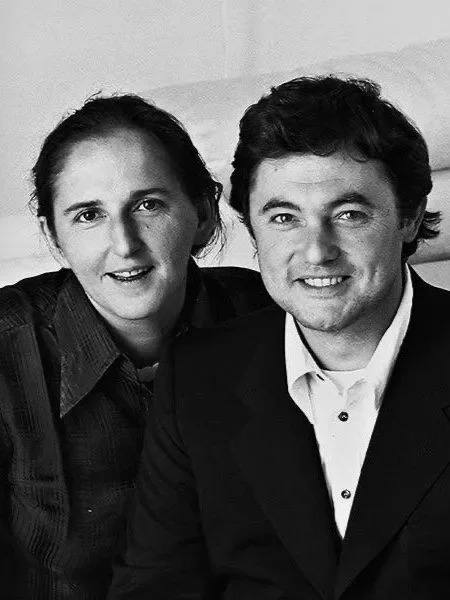
Tobia & Afra Scarpa
Tobia Scarpa was born in Venice in 1935, the son of the celebrated architect and designer Carlo Scarpa — a lineage that placed him, from the outset, inside one of Italian design's defining families. He studied architecture at the Università Iuav di Venezia, where he met Afra Bianchin (born in Montebelluna in 1937); the two married and built a professional partnership that lasted until Afra's death in 2011. Their first design, the Pigreco chair, emerged out of a university course taught by the architect Franco Albini in 1959 and was produced by Gavina — an unusually assured debut for two designers barely out of school.
In 1960 the couple opened their own design office in Montebelluna, in the Veneto countryside, and spent the following decades working across nearly every major Italian design house: the Bastiano sofa for Gavina, the Soriana armchair and Poltroncina 925 for Cassina, the Coronado sofa and later the Maxalto Artona collection for B&B Italia, and a sequence of lighting designs for Flos — including the Papillona lamp, among the first to use halogen technology. Their work is defined by a close, almost obsessive attention to material and craft, carried through everything from glass (Tobia's early training was at the Venini glassworks in Murano) to upholstered furniture to architecture.
Architecture ran alongside the furniture design throughout their careers, most notably a collaboration with the Benetton Group spanning more than three decades — beginning with the company's first textile factory in Treviso in 1964, and extending to interiors for its offices in Paris, Freiburg and New York. Afra and Tobia's furniture designs are held in the permanent collections of the Museum of Modern Art in New York, the Philadelphia Museum of Art, the Victoria and Albert Museum in London, and the Louvre in Paris. Tobia Scarpa received the Compasso d'Oro for the Soriana armchair in the late 1960s and a lifetime achievement Compasso d'Oro in 2008; he turned ninety in 2025 and continues to work from Venice.