

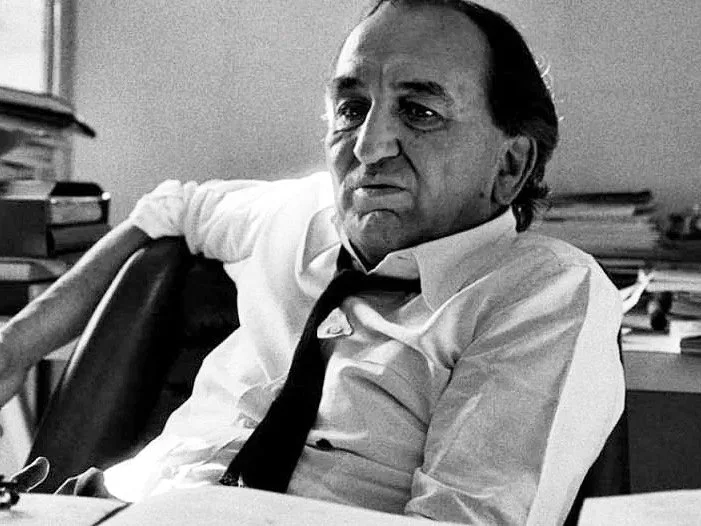
Marco Zanuso
Marco Zanuso (1916–2001) was one of the architects who shaped postwar Italian design, and one of the first to treat furniture as an industrial problem rather than a purely decorative one. Trained as an architect at the Politecnico di Milano, graduating in 1939, Zanuso opened his own Milan studio in 1945 after serving in the Italian Navy during the war. In the years that followed he co-edited Domus with Ernesto Nathan Rogers and later edited Casabella, using both platforms to argue for a design culture built around new materials, new manufacturing methods, and serial production — the same set of concerns that would define his own furniture.
That argument became physical in 1948, when Pirelli launched Arflex to explore foam-rubber upholstery and asked Zanuso to design its first pieces. The Antropus chair (1949) and the Lady armchair (1951) were the result — the Lady, built in separate upholstered sections assembled at the final stage of production rather than as a single frame, won the gold medal at the Milan Triennale the year it launched and remains Zanuso's best-known design.
From the mid-1950s, Zanuso worked in close partnership with the German designer Richard Sapper, a collaboration lasting close to two decades and producing some of the defining objects of Italian industrial design: the K4999 stacking chair for Kartell (1961–64), the first chair made entirely of injection-moulded plastic; and the Doney portable television and TS502 radio for Brionvega, credited with reshaping how consumer electronics were allowed to look. Zanuso was a founding figure of ADI (Associazione per il Disegno Industriale) and later professor of industrial design at the Politecnico di Milano.