

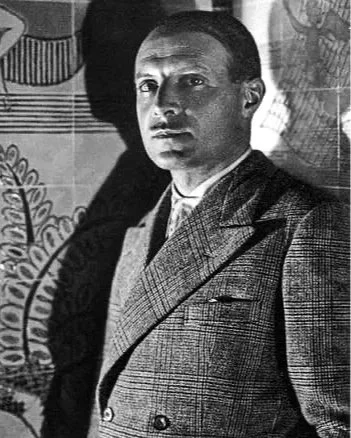
Gio Ponti
Gio Ponti is one of the central figures of twentieth-century Italian design — an architect, industrial designer, teacher, writer and publisher whose six-decade career shaped how Italy thought about modern living, not just how it furnished it. Born in Milan in 1891 and trained as an architect at the Milan Polytechnic, Ponti moved fluidly across disciplines in a way that made him genuinely difficult to categorise: over the course of his career he designed buildings, furniture, ceramics, glassware, lighting, silverware and fabric, often within the same decade.
His architectural practice ran in parallel partnerships across the decades — first with Mino Fiocchi and Emilio Lancia through the 1920s, then, from 1933, with engineers Antonio Fornaroli and Eugenio Soncini — producing significant commissions including Milan's Montecatini headquarters. His best-known building, the Pirelli Tower in Milan (1956–60), remains one of the defining images of Italian post-war modern architecture. In furniture, Ponti designed the Superleggera chair for Cassina in 1957 — an almost impossibly light ash chair, built with cabinetmaker Giordano Chiesa, that remains one of the most recognisable objects in Italian design history — alongside earlier, more decorative work for manufacturers including Casa e Giardino and the department store La Rinascente, and colourful, neoclassical ceramic designs for the Richard Ginori pottery factory through the 1920s and 30s.
Equally significant was his role as an editor and cultural advocate: in 1928, Ponti founded Domus, the architecture and design magazine that became one of the most influential platforms in twentieth-century design publishing, and he directed it — with one interruption in the 1940s to run his own short-lived magazine, Stile — for roughly 45 years in total. Through Domus and his involvement in the Milan Triennale, Ponti did as much to define and promote Italian design internationally as he did to produce it. He described himself, with characteristic wit, as "a failed architect and failed painter" — a modest verdict on a career that shaped an entire national design identity.