

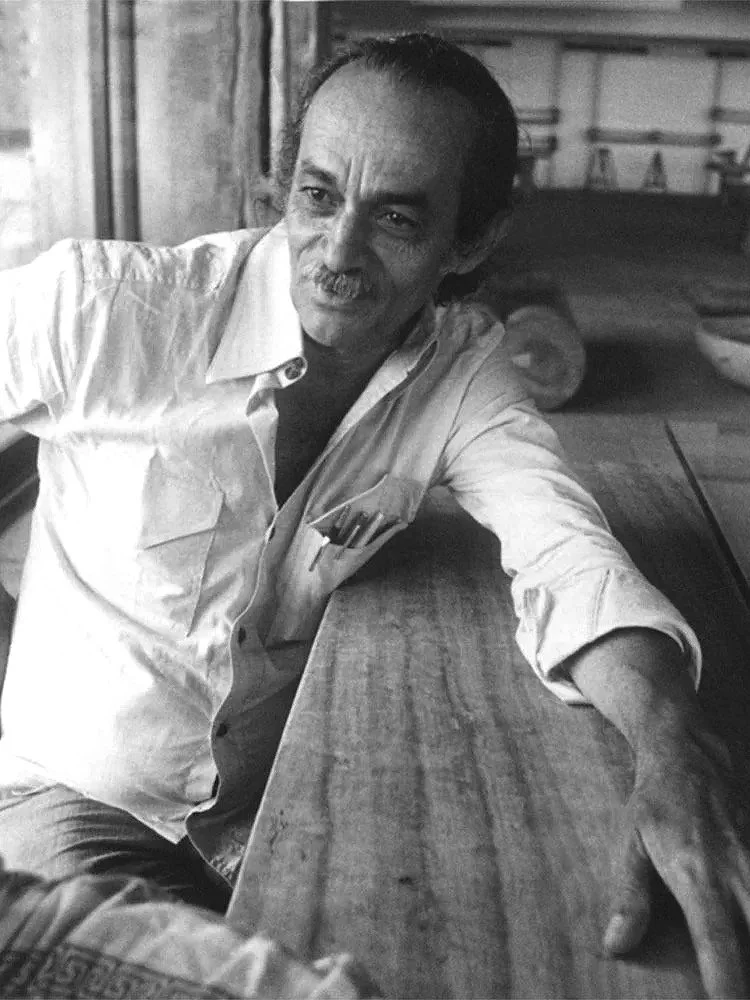
José Zanine Caldas
José Zanine Caldas was a self-taught Brazilian architect, sculptor and furniture designer — sometimes called "Mestre da Madeira," the Master of Wood — whose career moved through two almost opposite phases, both rooted in the same material obsession. Born in Belmonte, Bahia, in 1919, he never trained formally as an architect. He began as a draftsman in São Paulo at eighteen, and in 1941 opened a workshop in Rio de Janeiro building architectural scale models — eventually producing several hundred models for Brazil's leading modernists, including Oscar Niemeyer and Lúcio Costa, whose admiration for his work followed him for the rest of his career.
In 1949 Caldas founded Fábrica Móveis Artísticos Z, producing standardised plywood furniture aimed at a wide public — an industrial, democratic approach to modern design. He grew disillusioned with that commercial model and, from the 1970s, relocated to the coastal town of Nova Viçosa, where his practice inverted entirely. Watching the region's forests logged around him, he began working only with fallen or already-felled timber, carving large-scale furniture directly from single trunks and stumps — a body of work that became known as Móveis Denúncia, "protest furniture." Where his earlier work stood for standardisation, this later work stood for the opposite: unrepeatable, sculptural pieces that kept the wood's knots, cracks and natural form intact, made as a deliberate statement against deforestation.
Caldas's work has been exhibited at the Musée des Arts Décoratifs in Paris (a 1989 retrospective, "Zanine — Architecte et Forêt") and at Rio de Janeiro's Museum of Modern Art ("Zanine 100 Years — Form and Resistance"), and was included in the 2015 travelling exhibition Moderno: Design for Living in Brazil, Mexico and Venezuela 1940–1978, organised by the Americas Society. In 1991, the Académie d'Architecture in Paris awarded him its silver medal for architecture — recognition of a career built entirely outside formal architectural training.
Our Process
Each stage is deliberate, honoring time-tested craft and bespoke intent.
Clarity of purpose
This exchange cultivates trust and sets a refined tone.
Elevated cohesion
Materials, textures, and narratives are handpicked for harmony.