

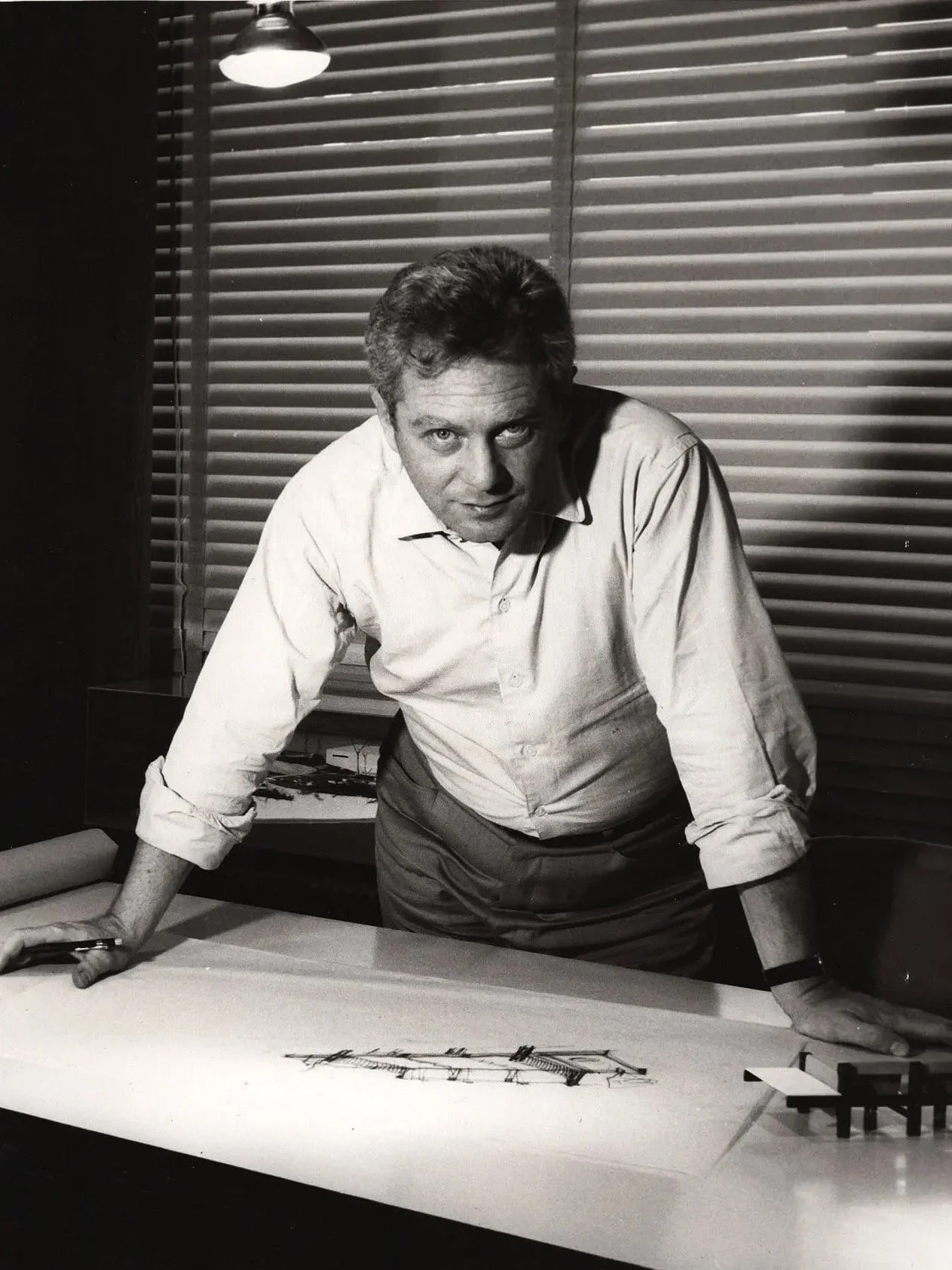
Jorge Zalszupin
Jorge Zalszupin (1922–2020) is among the most significant figures in twentieth-century Brazilian furniture design — an architect by training whose furniture would go on to define the visual language of Brazilian modernism as much as any building of the era.
Born in Warsaw in 1922, Zalszupin trained in architecture in Bucharest and worked in Paris before immigrating to Brazil, drawn by the work of Oscar Niemeyer and Roberto Burle Marx. He began his career in Rio de Janeiro before relocating to São Paulo, where in 1959 he founded L'Atelier — a furniture workshop that grew, at its peak, into two factories and ten retail showrooms across Brazil.
Zalszupin's furniture emerged directly from architecture: his earliest pieces were designed for the interiors of buildings he had worked on himself, born of necessity in a market where imported furniture was restricted and options were scarce. That architectural discipline shows in the work — considered proportion, structural clarity, and a level of craftsmanship that set L'Atelier apart from its contemporaries.
He worked primarily in jacaranda and other native Brazilian hardwoods, pioneering bent-plywood construction techniques in Brazil before expanding into steel, marble, fibreglass, and molded plastics — materials now commonplace in Brazilian furniture-making but experimental at the time. His custom pieces were selected by Oscar Niemeyer himself for two of Brazil's most significant government buildings, the Palácio da Alvorada and the Palácio do Planalto in Brasília.
Among his most recognised designs are the Poltrona Dinamarquesa (Danish Chair) — his first independent design and now considered an icon of Brazilian modernism, its curved arms and tapered legs echoing the architectural lines of Niemeyer's Alvorada Palace — alongside the Pétalas table series and the Presidencial and Brasiliana armchairs, all developed in 1959 as L'Atelier's practice matured.
Zalszupin died in 2020, leaving behind a body of work now held by design galleries and private collectors internationally, and a legacy that continues to shape how Brazilian design of this era is understood. His pieces have been exhibited at the Museum of Modern Art (MoMA) in New York, as part of Crafting Modernity: Design in Latin America, 1940–1980 (2024), and at the Museu da Casa Brasileira in São Paulo, which marked what would have been his hundredth year with the exhibition Synthetic Organic: Zalszupin 100 Years (2022). His São Paulo home has itself been preserved and opened to the public as Casa Zalszupin, a dedicated space celebrating his life and work. As fellow São Paulo designer Guilherme Wentz has said: "I'm not sure I could be a furniture designer in Brazil at this level today without the contributions of Jorge Zalszupin."