

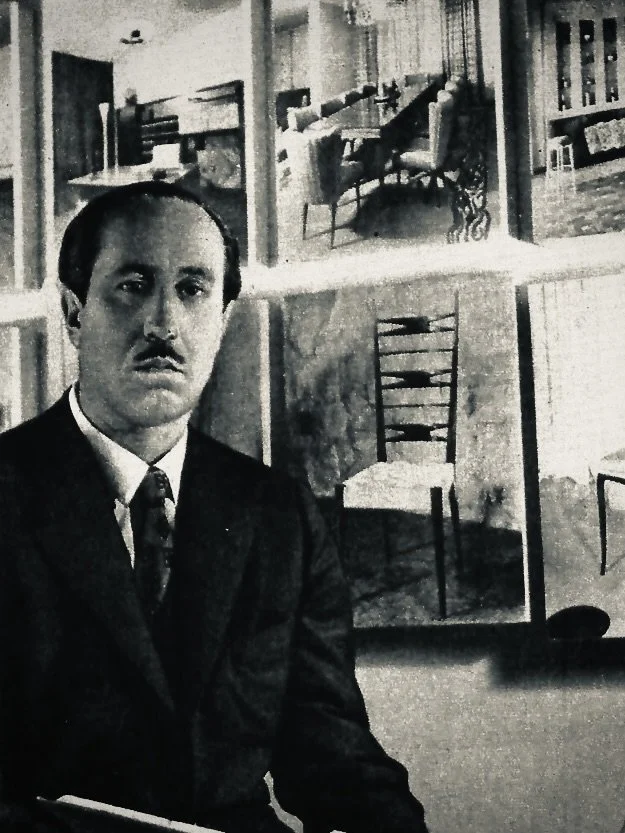
Guiseppe Scapinelli
Giuseppe Scapinelli sits at the exact seam Colecta specialises in — an Italian architect who built his entire design career in Brazil, and whose work reads as neither purely Italian nor purely Brazilian but as something genuinely fused from both. Born in Modena, Italy, where he had worked as an architecture professor, Scapinelli obtained his architecture diploma in 1941 and emigrated to São Paulo in 1948, part of the postwar wave of Italian architects, artists, and intellectuals who resettled in Brazil. He founded his own architectural practice in São Paulo in 1950, and it was from that base that he moved into furniture design — establishing his own manufacturing operation, the Fábrica de Móveis Giesse, alongside a rug factory, the Fábrica de Tapetes Santa Helena.
Scapinelli's furniture is immediately distinguishable from that of his Brazilian modernist contemporaries: where designers like Zanine Caldas and the Móveis Artesanal circle pursued increasingly angular, structurally exposed forms, Scapinelli held to soft curves, slender tapered "toothpick" legs, and delicate metal detailing — a more classical, decorative sensibility filtered through Brazilian materials, chiefly solid caviúna wood. A 1950s profile in the magazine Casa e Jardim captured this tension neatly, describing him as a classicist who never forgot to be modern.
Beyond the factory floor, Scapinelli operated two São Paulo storefronts, Le Rideau and Margutta — the latter doubling as his personal atelier and a informal gathering point for the European émigré design community in the city, where architects, artists, and intellectuals met to discuss the design currents of the day. He also wrote a regular advice column, "Scapinelli Responde," for Casa e Jardim, putting him in front of a mainstream readership in a way few of his furniture-making contemporaries achieved. His approach to commissions was architectural in the fullest sense: rather than designing an isolated piece, he typically conceived a client's rooms as a complete environment — furniture, rugs, curtains, lighting, and artwork considered together.
Scapinelli died in 1982 and fell into relative obscurity for roughly three decades before being rediscovered by collectors and design historians in the 2010s. His work is now reissued by the Brazilian design house Etel and increasingly sought after internationally — a genuine case of a significant mid-century name recovered from near-total disappearance.