

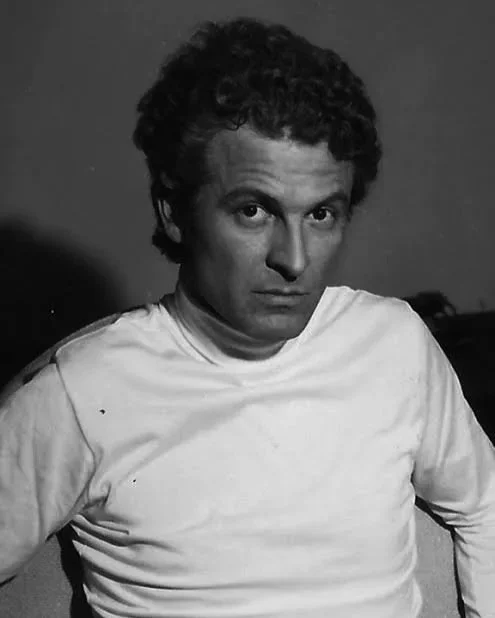
Pierre Pualin
Pierre Paulin (1927–2009) redefined what an upholstered chair could be — treating foam, elastic fabric, and a tubular steel frame as sculptural material rather than as cushioning for a traditional wooden form. Born in Paris, Paulin originally trained as a sculptor, studying ceramics in Vallauris and stone-carving in Burgundy, before an arm injury ended that path and redirected him to the École Camondo. He went on to work in Marcel Gascoin's studio in Le Havre, where his exposure to Scandinavian and Japanese design left a lasting mark on his own sense of form.
Paulin made his design debut in 1953, and by the following year was designing for Thonet, stretching swimwear-grade fabric over otherwise conventionally built frames — an early version of the technique that would define his career. His most significant body of work came through a long partnership with the Dutch manufacturer Artifort, beginning in the late 1950s, which produced the Mushroom chair (1959), Ribbon chair (1966), and Tongue chair (1967), among others — pieces built from steel frames, latex foam, and stretch fabric, with no visible joinery or traditional upholstery seams.
Paulin's reputation extended beyond furniture manufacturing into French state commissions: he designed banquette seating for the Louvre in the late 1960s, and in the 1970s was commissioned by the Mobilier National to design the private apartments of President Georges Pompidou at the Élysée Palace, later furnishing office space for President François Mitterrand in the 1980s. His work is held in the permanent collection of the Museum of Modern Art, New York.