

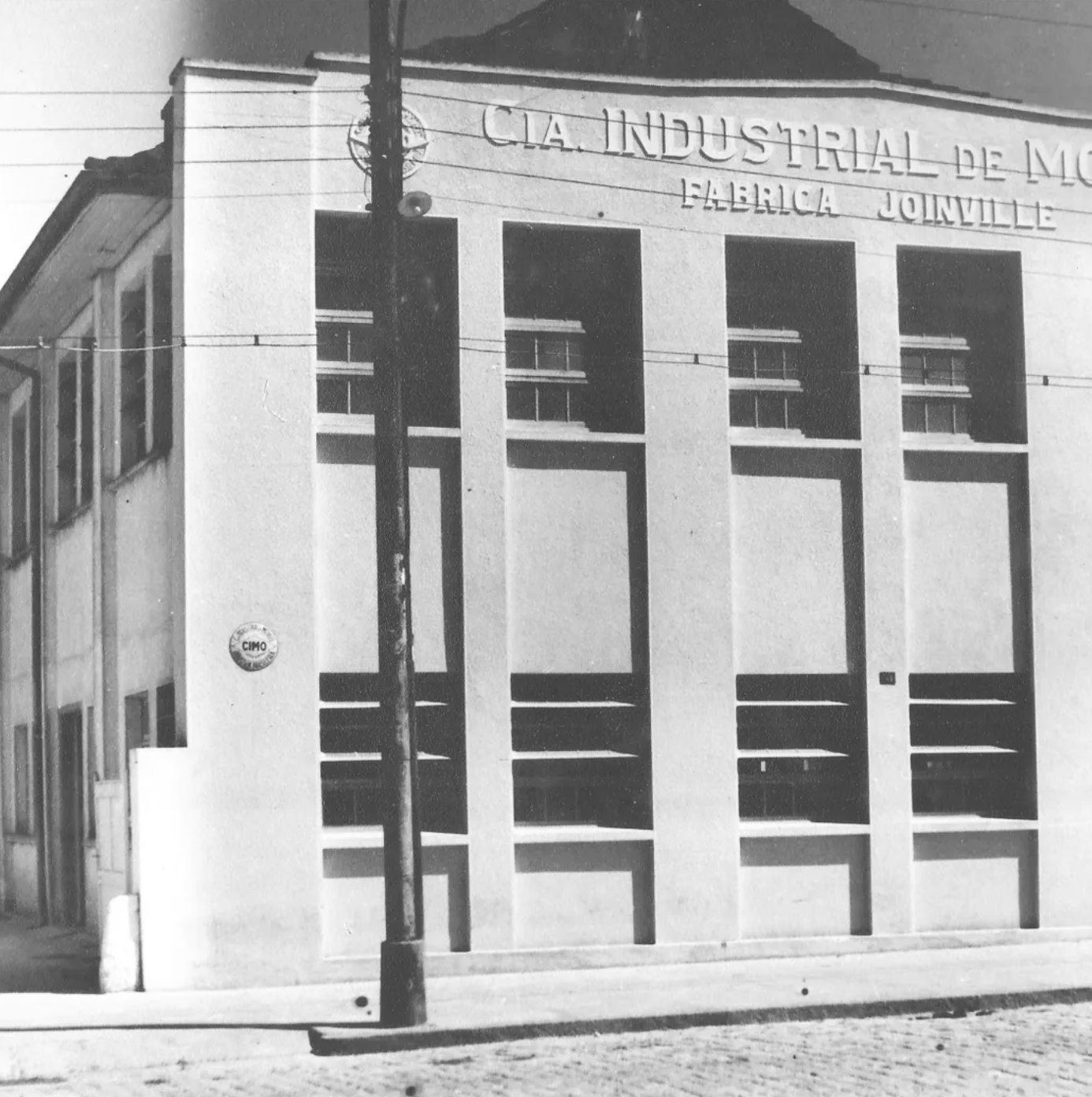
Móveis CIMO
Móveis CIMO — formally Companhia Industrial de Móveis — grew from a sawmill and box factory into what became, for a period, the largest furniture manufacturer in Latin America. It was founded by Jorge Zipperer and Willy Jung, who opened a general store together in the town of São Bento (now São Bento do Sul) in 1912, then acquired land nearby at Rio Negrinho, Santa Catarina, to build a sawmill and box factory the following year. The furniture business began, almost incidentally, as a way to use the imbuia offcuts left over from box production.
The company changed hands and names several times through the 1920s and 30s — Jung's death in the 1919 influenza pandemic left Zipperer to continue alone — before reorganising in 1932 as a joint-stock company. It eventually merged with six other furniture manufacturers to form Companhia Industrial de Móveis S/A, and the acronym stuck: CIMO, later formalised as Móveis Cimo S/A in 1954. At its height the company operated factories across Rio Negrinho, Curitiba, Joinville and Rio de Janeiro, employing more than 5,000 people directly and supplying furniture at genuine industrial scale — homes, schools, public institutions, offices, theatres and cinemas across Brazil.
Cimo's significance to Brazilian design history lies less in a single design signature than in its scale and reach: it industrialised what smaller ateliers like Oca or L'Atelier were producing by hand, bringing clean, modernist forms in native hardwoods — principally imbuia and jacaranda — to a much broader Brazilian public. The company went bankrupt in 1982, but its mid-century output is now widely collected for exactly the qualities that made it commercially successful at the time: honest materials, restrained proportion, and construction built to last & be used for a lifetime.